
The short answer on Gaggenau versus Sub-Zero: pick on layout and cooling design, not on a belief that one is simply better made. Sub-Zero builds its Classic refrigerators around two independent cooling systems and sells built-in widths from 30 up to 48 inches, while Gaggenau leans toward slim, fully integrated columns such as the 30-inch RC472705, which holds 16.8 cu.ft. (475 litres) and runs at a quiet 40 dB. Both are premium machines meant for long service lives, so the real differences are how they fit your cabinetry, how they store food and what keeping them running looks like years from now.
Two different ideas of a built-in
Sub-Zero makes refrigeration and nothing else, and its current lineup has three families: Classic, Designer and PRO. Those names date from March 2019, when the old Built-In series became Classic and the Integrated series became Designer, while PRO stayed as it was. If your paperwork or an older listing says Built-In, it is describing what Sub-Zero now calls Classic.
Sub-Zero itself steers buyers by placement. Classic is the suggested line for a freestanding install, or for one where a side panel of the cabinet remains visible. Designer shows far less metal and is intended to melt into the surrounding cabinets.
Gaggenau comes at refrigeration from the other direction. It is best known for cooking appliances, and its refrigerators mostly take the form of columns that hide completely behind custom panels, which you can line up as a refrigerator, a freezer and a wine unit side by side. It also offers combination freezer refrigerators such as the RVB497790. Gaggenau belongs to the same European group as Bosch and Thermador, which matters later when parts come up.
How each one keeps food cold
Sub-Zero’s signature is Dual Refrigeration in its Classic units. The refrigerator and freezer each get their own system, so fresh-food smells never reach the ice or frozen food, and the fresh section’s air keeps its moisture instead of being dried out by the freezer. Produce and cheese tend to hold up well in that humid air.
A Gaggenau column layout reaches a similar separation by a simpler route: the refrigerator column and the freezer column are separate appliances, each cooling only its own space. The RC472705 lets you set the fresh-food temperature anywhere from 35 °F to 46 °F, and the RVB497790 manual recommends 37 °F (3 °C) for the refrigerator and 0 °F (-18 °C) for the freezer. Those two figures are a sensible target for either brand.
Sizes, grilles and cabinetry
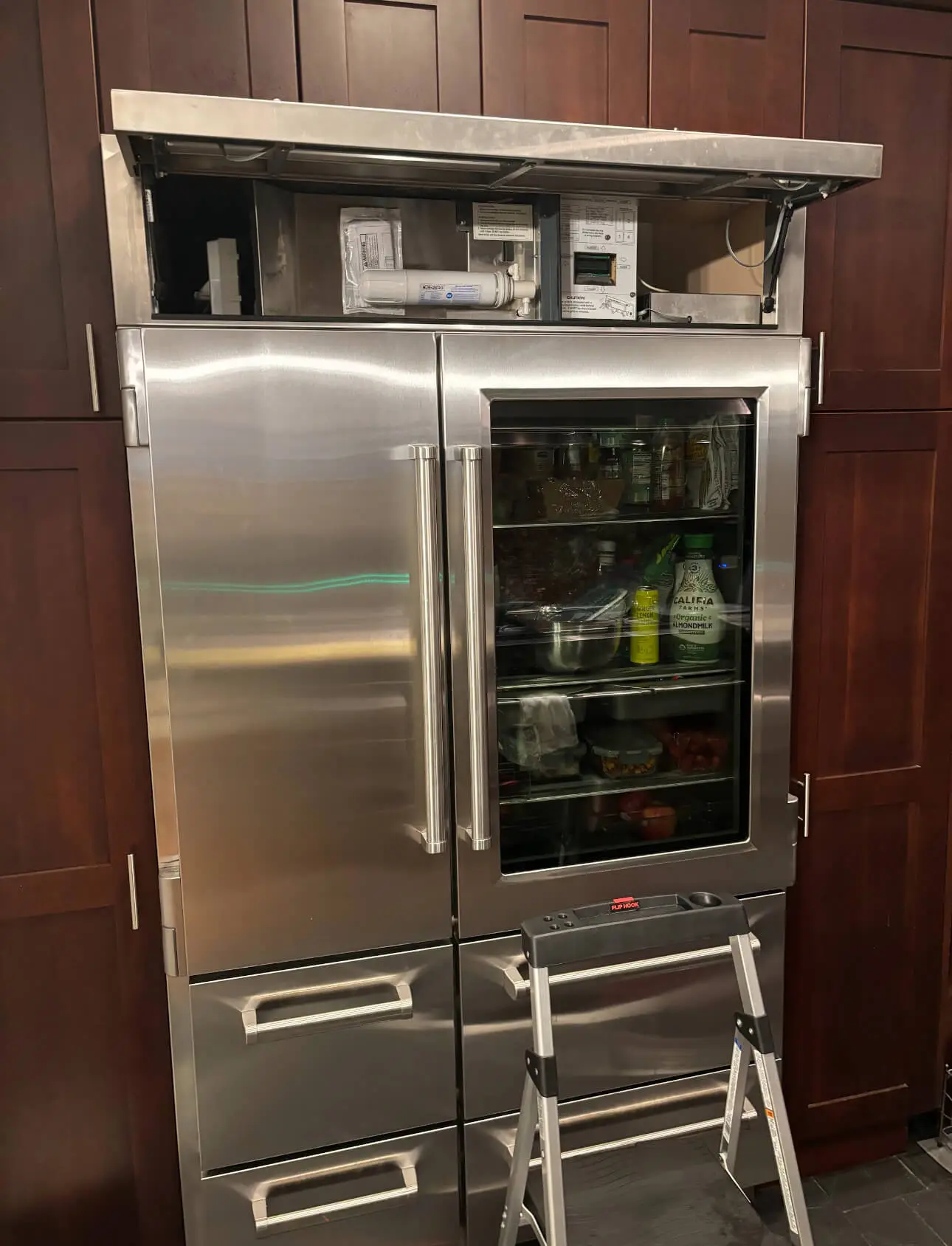
Sub-Zero lists Classic widths of 30, 36, 42 and 48 inches, each with a flip-up grille at the top that hides the condenser. Designer comes in 24, 30 and 36 inches with its grille down at the bottom. Gaggenau sells individual columns, so a wider run is made by pairing units rather than buying one big cabinet.
If you are replacing an older built-in in an existing opening, the width you already have often settles the question. A 42- or 48-inch gap suits a Classic unit, whereas a run of narrower openings or a wall of matching panels suits columns from either brand. Fully paneled doors carry real weight, so hinge adjustment and door alignment deserve attention on any integrated install.
Where problems tend to show up
Neither brand has a single weak spot that defines it; both tend to fail in the familiar places, such as condensers clogged with dust, tired fans, defrost faults, worn door gaskets and ice makers. Layout changes where you look first.
On a Sub-Zero Classic, the condenser behind that top grille pulls in lint and dust from the kitchen, and a clogged coil makes the compressor run long and hot. Because each side has its own system, a fresh-food section that warms while the freezer stays solid points to that side alone. Our page on a refrigerator that is warm while the freezer is fine walks through the checks, and Sub-Zero refrigerator repair covers what a technician does next.
Gaggenau units lean heavily on electronic controls. Before assuming a failed part, rule out the simple settings: on the RVB497790, a unit with working lights and displays that refuses to cool may simply be sitting in showroom mode, found under Settings, then Advanced, then Demo mode. More on the brand is on our Gaggenau page.
Upkeep and service along the coast
Two local conditions shape upkeep here. Homes near the water in La Jolla, Del Mar and Encinitas breathe salty, damp air, which is hard on condenser fins and electrical contacts, so cleaning the coil more often than once a year pays off. San Diego tap water is also hard, and minerals shorten the life of filters and ice maker parts. Gaggenau asks for a new filter on the RVB497790 every 6 months, or sooner when the Replace filter notice lights or the water stream visibly weakens; a home with a whole-house filter can use a bypass cap instead. Our Sub-Zero maintenance service covers the condenser side of that routine.
Parts are the other practical difference. Sub-Zero parts are widely stocked across the country, while some Gaggenau components travel through the same supply channels as Bosch and Thermador and may need to be ordered, so allow for a short wait on less common repairs.
Smith Appliance Repair is an independent service that is not affiliated with Sub-Zero or Gaggenau, and we work on both across San Diego County, from Carlsbad to Rancho Santa Fe. A visit starts with an $89 service call; reach us at (949) 979-4880 or through the booking button on this page.
Which one fits your kitchen
Choose a Sub-Zero Classic if you want one wide cabinet with two independent systems, or if the sides will show. Choose Sub-Zero Designer or Gaggenau columns if you want the refrigerator to disappear into the cabinetry, and lean toward Gaggenau if you value a very quiet unit or already cook on Gaggenau and want the kitchen to match. Whichever you pick, a clean condenser, a fresh filter and correct temperature settings do more for its lifespan than the badge on the door.