Common problems

Why is my refrigerator not cooling but the freezer is fine?

Short answer

A warm refrigerator with a working freezer almost never means a failed compressor. Smith Appliance Repair checks the refrigerator circuit first — fan, defrost, damper — on (949) 979-4880.

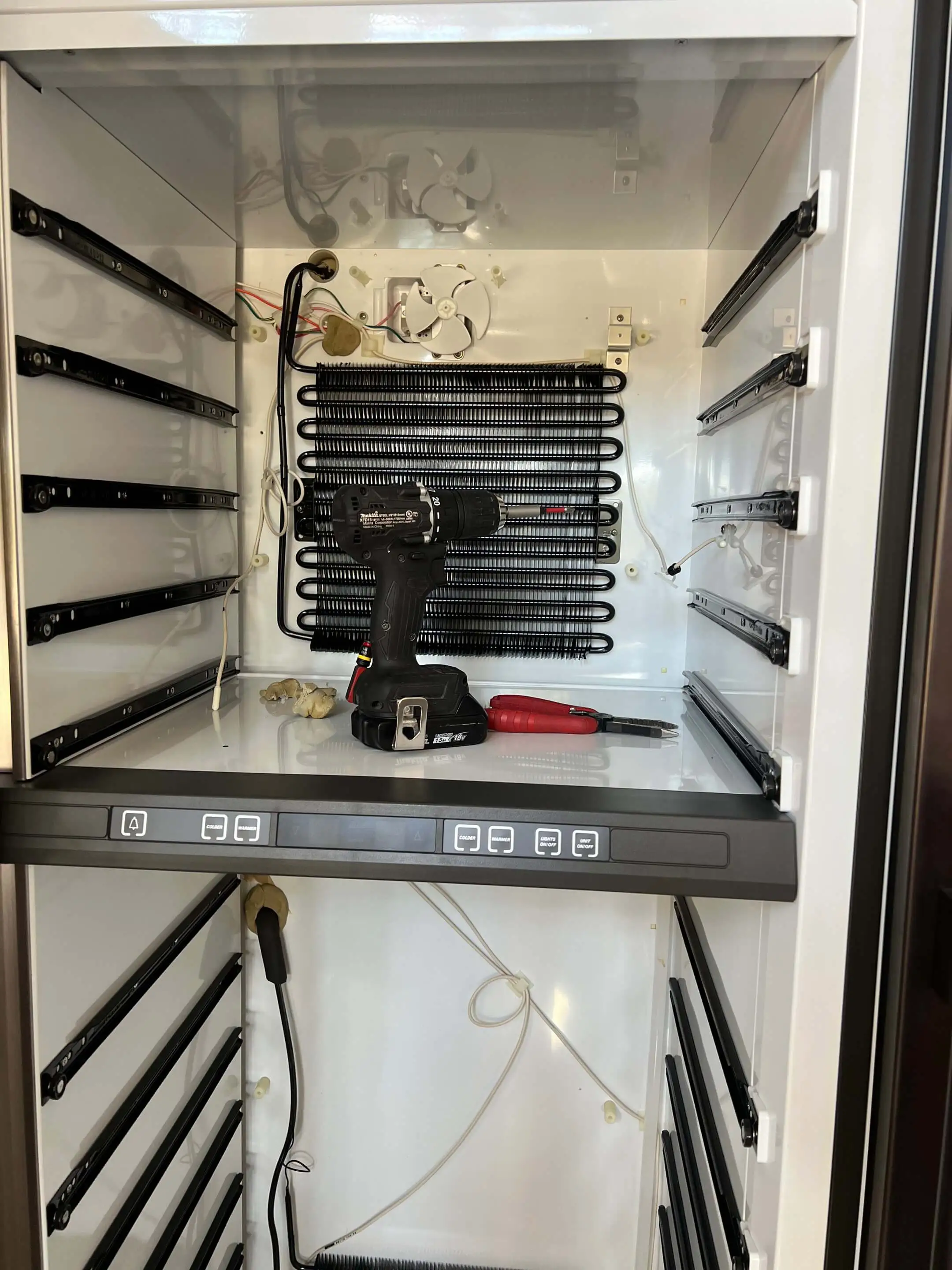
Sub-Zero calls its architecture dual refrigeration, and on the premium built-ins generally the sealed system is split in two, so a cold freezer proves one of them is healthy; on a single-system fridge the freezer would fail first. What has actually failed is on the refrigerator side: the evaporator fan that moves cold air into the fridge compartment, a defrost fault that has iced the evaporator over, or the damper that meters air between the two. All three are ordinary parts and all three are usually a same-visit repair.

The rear panel off a built-in refrigeration column, evaporator coil and both fans exposed — the parts that fail when the fridge is warm and the freezer is not

Diagnosis

What it usually turns out to be

Listed roughly in the order a technician checks them — which is not the order of how expensive they are, but of how likely.

Most common

Evaporator fan motor

The fan that pushes cold air into the refrigerator compartment has stopped or slowed. The system still makes cold — it just is not being delivered. Often audible: the fridge is quieter than it used to be.

Most common

Defrost fault icing the evaporator

A failed defrost heater or a drifted thermistor lets frost build on the coil until it insulates itself. Cooling degrades over days rather than failing all at once, which is why people describe it as "getting worse".

Common

Air damper stuck

On models that meter air between compartments, a damper stuck shut starves the fridge while the freezer runs normally.

Common

Door seal on the fridge side

A gasket that has lost its magnetic pull leaks warm air continuously. Test it with a banknote: close the door on it and if it slides out without resistance the seal is done.

Less common

Control board or sensor

The control is reading a wrong temperature and behaving accordingly. We verify the sensor before condemning the board — a board swap that fixes nothing is the most expensive wrong answer here.

Less common

Refrigerator-side sealed system

Genuinely possible on a dual-system unit, and the only expensive outcome on this list. It is also the one that is diagnosed last, because the four causes above account for the large majority of these calls.

When to stop and call

If the freezer is cold and the fridge is above 40°F, food safety is already in play. Move perishables to the freezer or a cooler and call — this is a same-day job for us.

Before you call

What you can safely check yourself

  • Check the freezer is genuinely cold — if both sections are warm, this is a different fault and a different page.
  • Listen for the evaporator fan when the fridge door is closed; opening the door stops it by design, so listen with the door shut and the light switch pressed in.
  • Look at the rear wall inside the fridge for a sheet of frost. Frost that returns after you clear it is a defrost fault, not a cleaning problem.
  • Close the door on a banknote and pull. No resistance means the seal is leaking.
  • Make sure nothing is blocking the vents inside the compartment — a full fridge packed against the back wall can starve its own airflow.

Nothing above asks you to open a sealed system, meter a live board or bypass a safety device. If a step needs any of those, it is not on this list.

More on this

Can I fix this myself?

You can rule things in or out with the checks above, and clearing a blocked vent is genuinely a homeowner fix. Replacing an evaporator fan or a defrost heater on a built-in means removing the rear panel and working around a charged sealed system, which is where it stops being a home repair.

How long can food stay safe?

The FDA guidance is four hours above 40°F. If the compartment has been warm overnight, treat what is in it as suspect regardless of how it looks.

Is it worth repairing?

On a built-in, almost always. These are twenty-year machines and the parts involved here are a fraction of the cost of replacing a unit that is panelled into the cabinetry.

Reviews

What Our Customers Say

Real reviews from real customers across San Diego County.

Rachel D.
January 2026
★★★★★

He was incredibly professional and efficient, responded immediately to our inquiry. Even though our appliance was beyond repair, he still did what he could to help us figure out next steps. 100% would call again for any issue.

James K.
December 2025
★★★★★

Our Sub-Zero stopped cooling and I was panicking about losing all our food. Vlad came same day with the parts already in his van. Fixed it in under an hour. This is what real service looks like. Highly recommend!

Sharon M.
January 2026
★★★★★

He was at my house in less than 30 minutes. He quickly diagnosed the issue and ordered the part. My machine was up and running in 2 days when I had anticipated a 1-2 week wait. I can’t recommend him enough!

5.0Google Reviews
4.8Yelp Reviews
5.0Thumbtack

1,284+ reviews across all platforms. These are real, verified customer reviews.

Your Appliance Won't Fix Itself

Same-day appointments available. The $89 diagnostic is waived when you go ahead with the repair.

8am – 7pm, seven days a week · Phone line open 24/7 for scheduling · Fully licensed and insured — California license #A50441.

Call Text Book